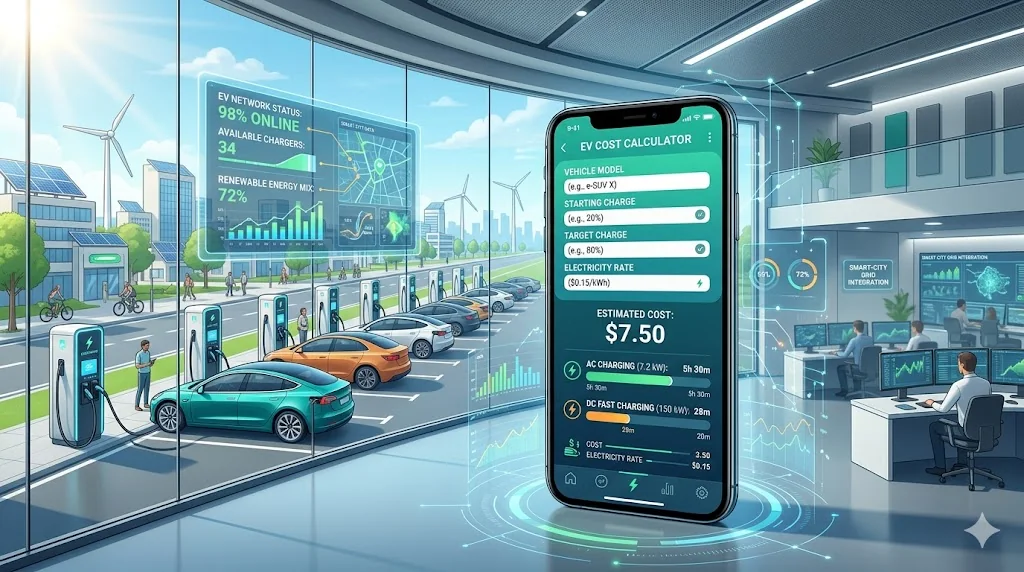
Home charging is where EV economics really shine. The US average residential electricity rate in 2026 is $0.17 per kWh, which translates to roughly 4–5 cents per mile for most EVs — compared to 12–18 cents per mile for gasoline vehicles. Here's what you'll actually pay, with a Tesla example you can benchmark against.
Tesla Model Y — The Benchmark
The Model Y Long Range AWD has an 80.5 kWh battery. At $0.17/kWh with 90% charging efficiency, a full 0–100% home charge costs about $15.20. Driven 13,500 miles per year at 3.7 miles/kWh, annual home charging runs approximately $650 — compared to $1,700+ for a comparable 28 MPG gas SUV at $3.50/gallon.
| State | Rate | Full Charge (Model Y) | Annual Cost |
|---|---|---|---|
| Louisiana / N. Dakota | ~$0.10 | ~$9 | ~$382 |
| US National Average | $0.17 | ~$15 | ~$650 |
| New York | ~$0.22 | ~$20 | ~$840 |
| California | ~$0.32 | ~$29 | ~$1,221 |
Three Charging Methods Compared
Level 1 (120V standard outlet): Uses your existing outlet, no installation needed. Adds 3–5 miles of range per hour. Fine if you drive under 40 miles/day and plug in overnight. Cost: your normal electricity rate.
Level 2 (240V home charger): Adds 25–35 miles per hour. A full charge overnight for any EV on the market. Installation runs $500–$1,200 including hardware and labor. This is the recommended setup for EV ownership — the same per-kWh cost as Level 1 but dramatically faster. Many utilities offer $200–$500 rebates.
DC Fast Charging (public stations): Tesla Superchargers typically cost $0.25–$0.50/kWh; third-party networks (Electrify America, EVgo) average $0.41–$0.61/kWh. A full charge can cost $25–$50 — 3–4× more than home charging. Best for road trips, not daily use. Network membership plans ($7–$15/month) reduce rates by $0.10–$0.12/kWh.
Off-peak rates are the biggest hidden saving: Many US utilities offer time-of-use (TOU) pricing with overnight rates as low as $0.08–$0.12/kWh. Setting your EV to charge between 11pm–7am can cut your annual charging cost by 30–50%. Check your utility's website for EV-specific rate plans.
How DC Fast Charging Stations Work — Is Energy Stored?
A common question: do DC fast chargers have batteries on-site, or do they pull straight from the grid? Most public DC fast chargers draw directly from the grid with no local storage. However, newer ultra-fast installations (350 kW+) increasingly use on-site battery buffers — typically 100–500 kWh lithium packs — to avoid expensive grid capacity upgrades. Tesla's V4 Superchargers and Electrify America's latest sites use these "battery-backed" designs in high-demand locations.
The electricity flows from the grid → transformer → charger power electronics → DC directly into your vehicle's battery pack, bypassing the car's onboard AC-to-DC converter. This is why DC fast charging is so much faster than AC charging — the conversion happens in the station, not the car, allowing much higher power levels.
Calculate Your Own Cost
Formula: Cost per mile = electricity rate ÷ EV efficiency (miles/kWh)
Example: $0.17 ÷ 4.0 mi/kWh = $0.0425/mile. Over 13,500 miles: $573/year.
VoltEV's cost calculator does this for every model in the database. Enter your electricity rate and annual mileage for your exact number — and see how it compares to petrol equivalents in your country.